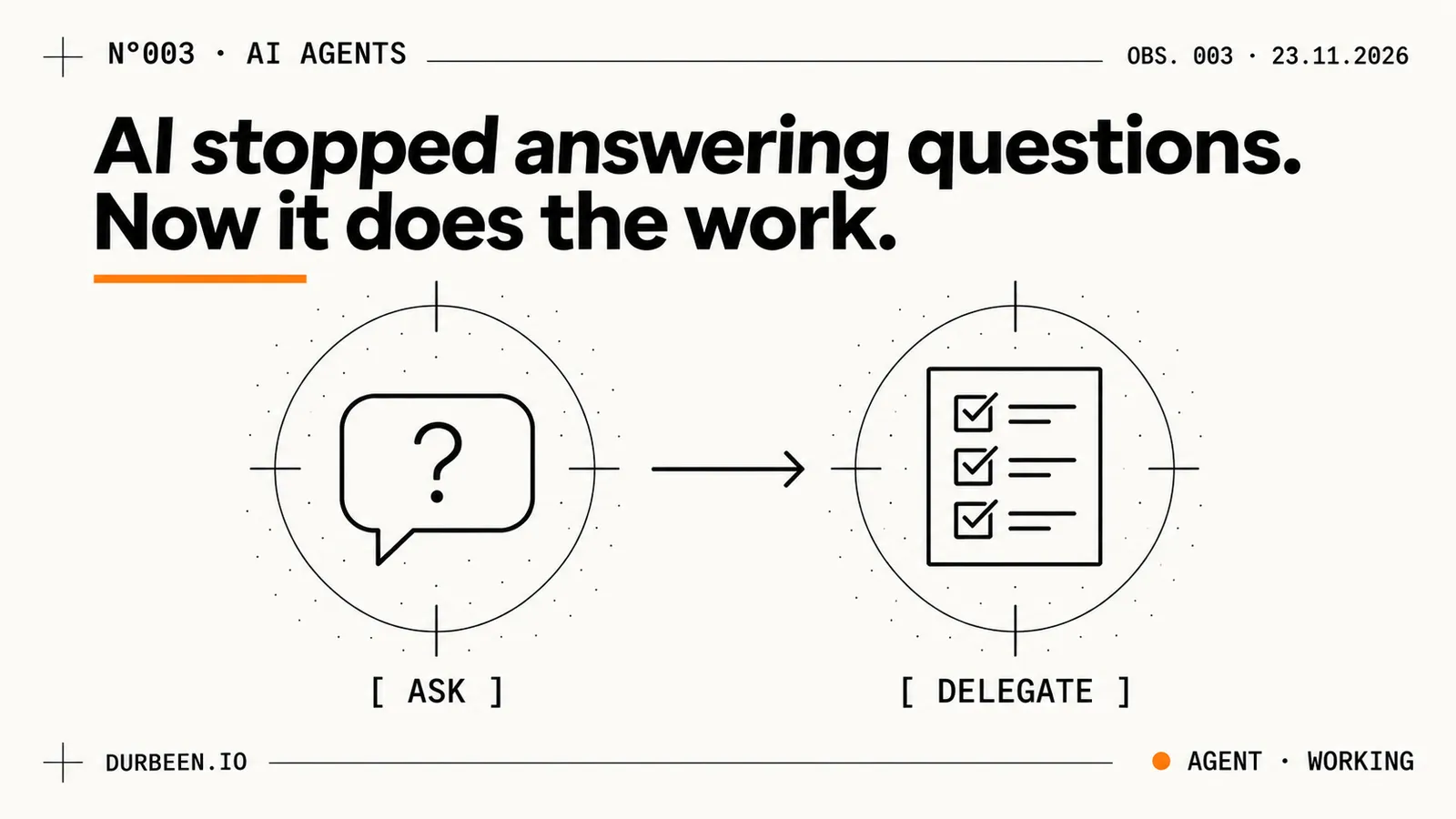
Until recently, you asked AI how to do something. Now you can ask it to do the thing.
That sounds like a small change. It is not. It changes who does the work, and who checks it.
From instructing to delegating
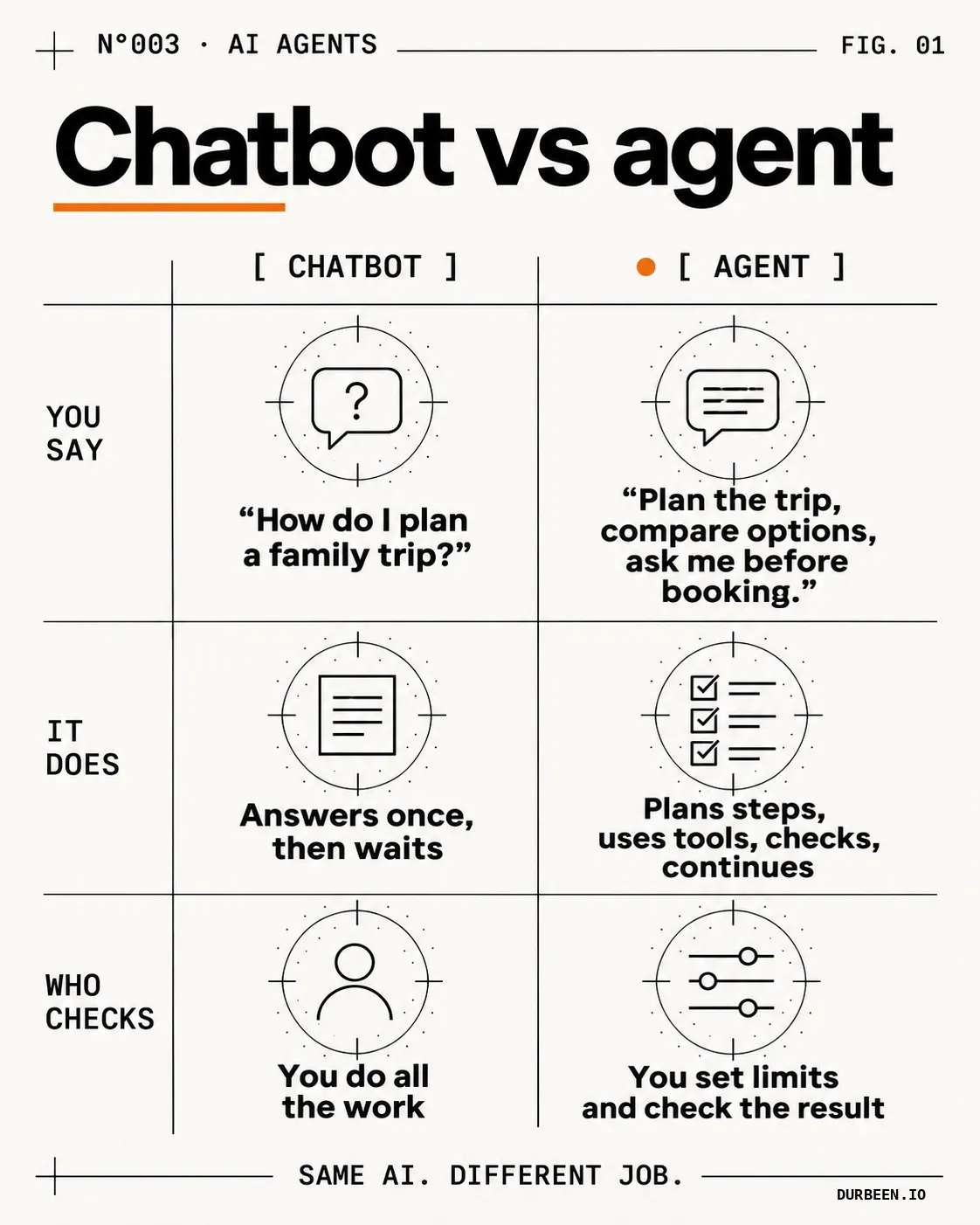
Ask a chatbot, “How do I plan a family trip?” and you get a list of tips. The work is still yours.
Now try this: “Plan the trip, compare the options, put it in a table, and ask me before booking anything.”
That is not a question. It is a job. Some tools can now take jobs like this. Not every tool can do it safely today, and the trip is only an example.
What an AI agent is
A chatbot answers one message and waits.
An agent works toward a goal. It decides its own next steps, uses tools, checks the result and carries on.
Anthropic, the company that makes Claude, draws a useful line. In a workflow, code fixes the steps. In an agent, the model directs its own process and tool use. You can read more in Anthropic’s guide.
A simple way to think about it: AI tools sit on a scale, from ones that only answer to ones that act with more independence. That is my way of seeing it, not an official classification.
How fast it is moving
METR, a research group, measures how long a task AI agents can finish. That length has grown exponentially for about six years, doubling roughly every seven months (METR).
METR’s own data suggests this has sped up in the last couple of years, to roughly every four months (METR, January 2026).
Two cautions. It is measured mostly on software tasks. And the faster pace may partly reflect which tasks are measured. I won’t guess where it goes next.
A real example: this website
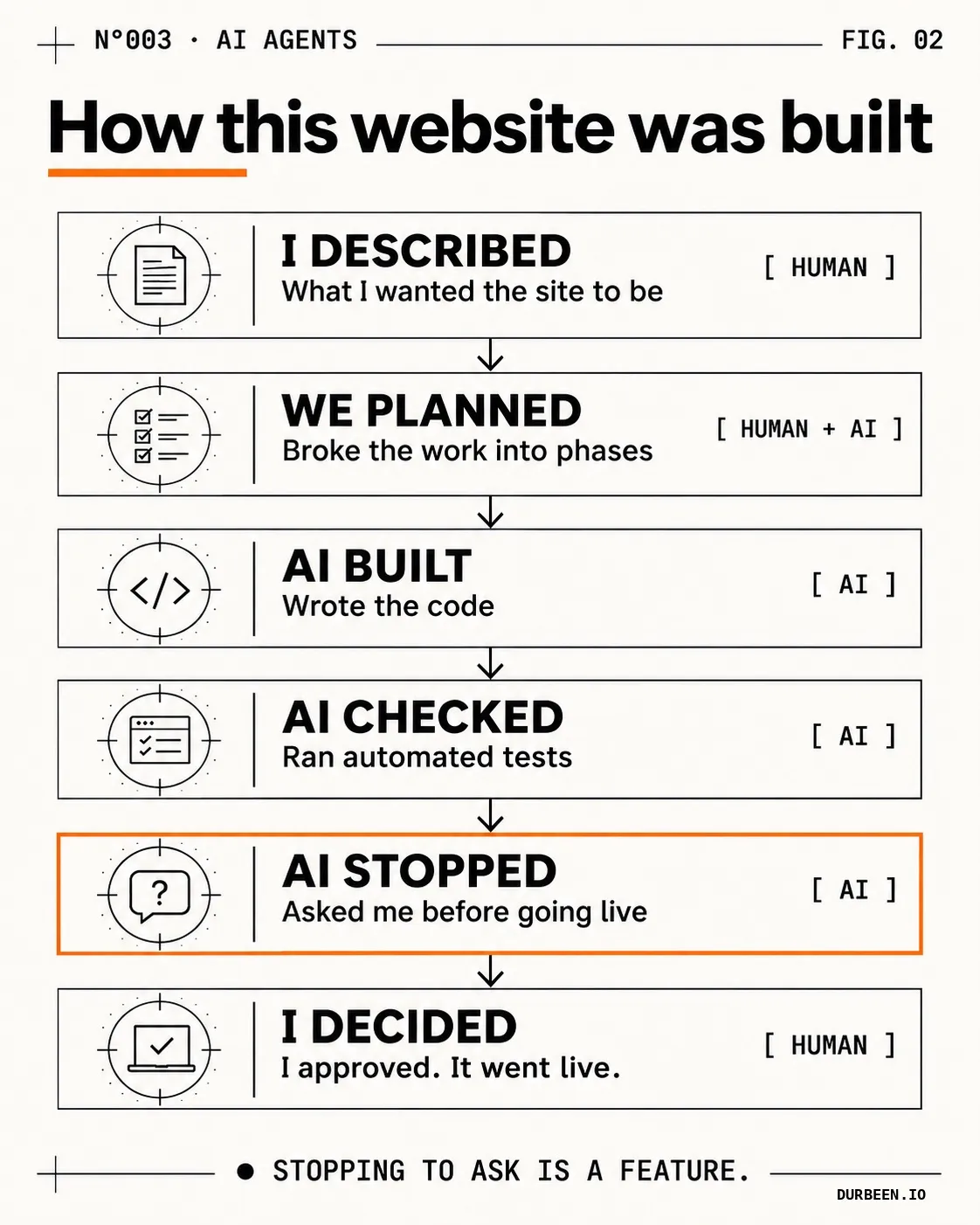
I built Durbeen with an AI agent. I described what I wanted the site to be. We planned the work together, in phases, outside the coding tool. The AI wrote the code and ran automated checks: build, accessibility, speed and broken links.
Then came the part that surprised me. On 22 November, before going live, it checked the domain and ran the pre-launch checks. It found the legal pages still marked “preliminary” and security headers missing. It stopped and asked for my decision instead of pushing ahead.
I decided, and the site went live.
Another time I pasted in a request meant for a different website. It noticed the mismatch, asked which project I meant, and changed nothing.
Sometimes the most useful thing an agent can do is stop and ask.
Access and permission
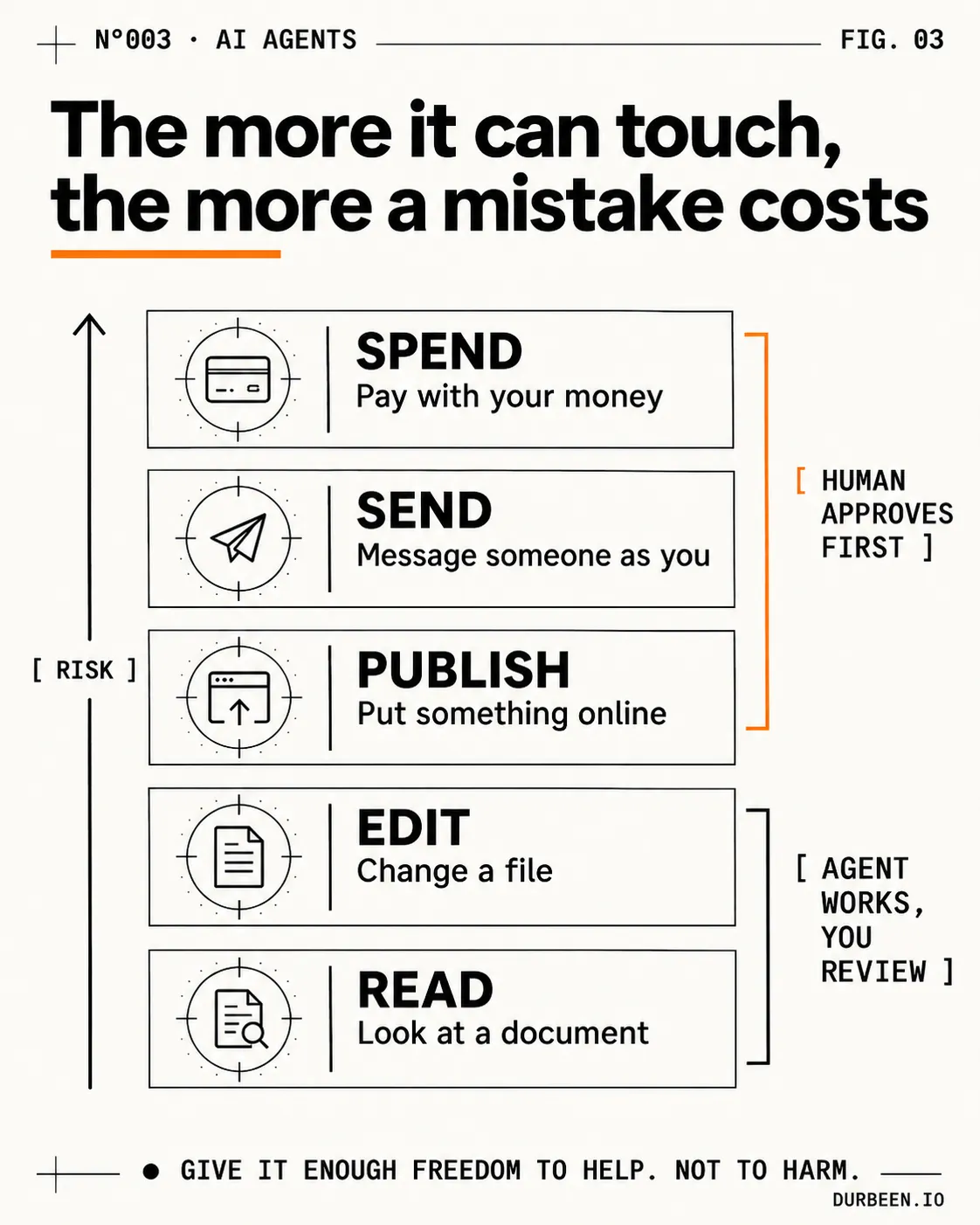
Here is a general way to think about risk. Not every action an agent takes costs the same if it goes wrong. Five levels, from low to high:
- Read: look at a document.
- Edit: change a file.
- Publish: put something online.
- Send: message someone as you.
- Spend: pay with your money.
The more an agent can touch, the more a mistake costs. At the low levels, the agent works and you review. At the high levels, you approve first.
This site is one example. The agent worked on code, but its edits still went through pull requests and automated checks. It had to ask me before costs, accounts, settings, DNS changes and going live. It did not need to touch every level.
Capable is not reliable
An agent can get nine steps right and the tenth wrong, and the result is still wrong.
It happened here. Once it wrote install commands from general knowledge instead of checking the official README. I had to verify them.
Another time it was too careful. My instruction said “no numbers”, so it removed a number that was correctly sourced.
The wider picture is similar. Gartner predicts that over 40% of agentic AI projects will be canceled by the end of 2027, because of costs, unclear value or weak risk controls. It also estimates that only about 130 of the thousands of “agentic AI” vendors are real (Gartner). Those are predictions, not facts.
What this means for you
Gartner also predicts that 40% of enterprise apps will include task-specific AI agents by the end of 2026, up from less than 5% in 2025 (Gartner). If that is right, you will meet agents inside tools you already use.
The skill that grows in value is not typing clever prompts. It is describing the outcome clearly, setting limits, deciding what to delegate and what to keep, and checking the result.
You still need real knowledge. Without it, you cannot tell good output from bad.
To try it safely:
- Start with one small, low-risk task.
- Set checkpoints where it must ask you.
- Always verify the result.
One last thing
You do not need to be a programmer to try this. Start small, stay in charge, and stay curious.